

“Who would say that if your child is raped at school that the parents shouldn’t know immediately? Who would say that?”
–Brian Heywood, founder of Let’s Go Washington, on Fox News
 There are two dangerous bills in Olympia targeting parental rights, and it is time for citizens to take a strong stand.
To do so, hundreds of concerned parents braved the cold and rain, and gathered on the steps of the Capitol in Olympia in order to voice their support for parental rights. FPIW was a co-sponsor alongside the Washington State Republican Party and Let’s Go Washington. It is a core part of our mission to defend parental rights, and we were proud to stand with our friends and allies to proclaim with Rep. Travis Couture: “We do not co-parent with the government.”
The rally focused on speaking out against Democrat lawmakers’ efforts to hijack Initiative 2081, which was passed into law by voters last year to create a Parental Bill of Rights. The initiative establishes 15 rights for parents with children in public schools, such as the ability to inspect their children’s medical or health records.
 Shortly after I-2081 was passed, several “hyper-partisan” Democrats began a ploy to undo parts of the parental bill of rights – an effort Rep. Couture called a “slap in the face to democracy.” The two bills in question are Senate Bill 5181 and House Bill 1296, which are being lobbied by lawmakers as “clean-up measures” to bring I-2081 “into alignment with existing law,” when in fact those bills would override the provisions established through the initiative by the will of the people.
While the Parental Bill of Rights (I-2081) requires schools to immediately notify parents when their children are the target of a crime committed at school, such as a sexual assault, SB 5181 would allow the school to wait 48 hours before notifying a parent their child was harmed.
My goodness – 48 hours. Can you image what the child would go through?
A graphic from the WA House GOP shows more details:

SB 5181 would also remove the provision that requires schools to notify parents when their children receive mental health counseling, including for gender dysphoria and suicidal ideation. Under the bill, students could even seek out help to obtain an abortion and the school would not be required to notify the parents that their child was undergoing surgery without their consent.
 “This left-wing ideology that the state raises children & that families don’t is just wrong,” WAGOP Chairman Jim Walsh stated.
On top of it all, there was another attack on parental rights from the Democratic Senate Majority Leader who said: “Kids over 13 have the complete right to make their own decisions about their mental health care. Parents don’t have a right to have notice. They don’t have a right to have consent about that.” To see the FOX News Special Report on his outrageous comments, click here.
I-2081 doesn’t need to be altered to align with state law – state law needs to follow the clear and constitutional provisions established by the initiative that the majority of Washington voters chose to adopt.
*****
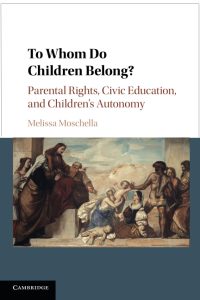 Scripture supports the belief that parents have primary authority over their children, and that includes the realm of education. Yet on the plane of logic unaided by faith, how can we defend the primacy of parental rights to those people who may not hold Scripture as an authority?
Dr. Melissa Moschella, author of To Whom Do Children Belong? (Cambridge University Press, 2017), lays out a logical argument defending parental rights:
Premise 1: As the biological cause of a child, parents have an intimate, irreplaceable, and permanent relationship with their child that no one else has. E.g., In a hospital, just imagine how you might feel if your baby were accidentally switched at birth.
Premise 2: This unique relationship gives parents moral obligations over a child.
Conclusion: Therefore, parents have authority to protect their unique relationship and moral obligations with a child against any threats, even against the government.
Given the fact of a unique relationship, and given the fact that this unique relationship generates obligations to a child, parents, therefore, need authority in order to fulfill their obligations. Moschella refers to “a kind of sphere of sovereignty” and “a little sovereign community” that “has the right to direct its internal affairs free from coercive external interference, except in cases of abuse and neglect.” It is true that children have a relationship with the wider political community and government. But as she notes, it is through their parents that children have this relationship, not despite the parent-child relationship. A child’s relationship with parents is pre-political. She writes:
Thus the fact that parents have the strongest and most direct obligation to raise their children to maturity implies that they are the ones with primary paternalistic authority over them . . . For it shows why and in what sense children naturally “belong” to their families, why separating children from their families robs them of important benefits and denies rightful authority to their parents . . . [S]ince parents, not the state, are the ones who have the closest personal relationship to their children and thus the strongest and most direct obligation for the well-being of those children, in part because the intimate relationship that they have with their children, makes them uniquely suited to meet their children’s developmental needs.
The benefits to the child are a unique love to help maturity as well as shape identity. Both common sense and social science overwhelmingly support the truth from human history that children do best when raised by their loving biological father and mother, all things being equal. Thus promoting the primacy of parental authority is for the common good of the child, the parents, and the society as a whole.
If you’re interested in exploring the topic of parental rights further, please click here to view our free booklet on the subject. You can also join our team of DEFENDERS to advocate for your values and parental rights in the public square. Learn more about FPIW’s policy views in our Issues Booklet here.
- Want to Change Our Culture? 500,000 DEFENDER Prayer Warriors Are Needed.
- Want to be Heard in Olympia? 200,000 DEFENDER Activists for Political Power Are Needed.
- Want to Change Washington’s Laws? 450,000 DEFENDER Signers of Initiatives & Referendums Are Needed.
- Want Lasting Change? 1.7 Million DEFENDER Voters for Conservative Candidates Are Needed.
Join us! Please sign up to become a DEFENDER today.
If you’re interested in exploring this topic further, please click here to view our free booklet on parental rights.

Sponsored by: FPIW Action • PO Box 5298 Lynnwood, WA 98046-5298 • 425-608-0242